As an Amazon Associate I earn from qualifying purchases. This page may contain affiliate links.
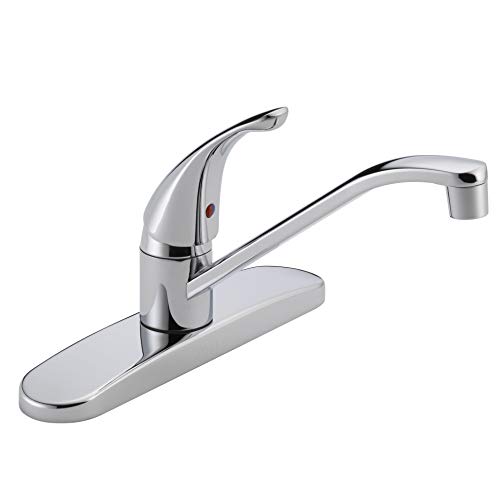
A kitchen faucet with single handle uses one lever to control both water temperature and flow, typically by moving the handle side to side for temperature and up or down for volume. It is the most common kitchen faucet style sold in the United States because it is quick to use and takes up less counter space than a two-handle setup. Most models rely on a single cartridge inside the body to do the mixing.
Why single-lever faucets became the default
A single-handle kitchen faucet is easier to operate with wet hands, dirty hands or an elbow, and that convenience is the main reason homeowners pick it. One motion gets you from off to full flow, and you can set a comfortable temperature without hunting for two separate knobs. The footprint is also smaller. A single-hole faucet fits a sink with only one mounting hole, which matters in older kitchens or in sinks where the counter has limited drilling options.
Shopping for one? See our guide: 7 Best Delta Single Handle Kitchen Faucets for Everyday Use (2026).
For many households the trade-off is worth it. Owners often report that a single lever is simpler for children and older adults, and it is easier to shut off completely, which helps when a pot is boiling and someone needs to step away.
Factors that affect how a single handle faucet performs
Not all single-handle kitchen faucets feel the same. Three factors matter most when you compare models.
The cartridge. Nearly all single-lever kitchen faucets use a cartridge that controls mixing and flow. Ceramic disc cartridges are common because they resist wear and give smooth, precise control. Cheaper designs may use a ball or compression-style mechanism that can feel loose after years of use. Check the manufacturer’s specifications for the cartridge type and whether it is a standard replacement part.
Hole count and mounting. Single-handle faucets may be mounted on a single hole or on a deck plate covering three holes. Measure your sink before buying. The mounting style determines whether you can later upgrade to a different faucet without new drilling. For guidance, see Measuring for a New Kitchen Faucet: Holes, Clearance, Fit.
Spray type and extra features. Many single-lever faucets come with a pull-down or pull-out spray head. A pull-down head drops into the sink and retracts with a weight, while a pull-out head stays attached to a flexible hose. Each design has limits on reach and hose length. Compare the options in Kitchen Faucet Types Explained: Pull-Down to Bridge and Pull-Down Kitchen Faucets: How They Work and What to Check.
Finish also matters for daily wear. Brushed nickel, stainless and matte black each hide water spots differently. The care differences are covered in Kitchen Faucet Finishes Compared: Looks, Care, Wear.
Single handle versus two handle
A two-handle faucet gives you separate hot and cold controls, which some cooks prefer for fine temperature adjustment. A single-handle model is faster for everyday tasks, but some people find it harder to dial in an exact temperature at first. Two-handle designs also tend to need more deck space and extra holes. If you are weighing both, Two-Handle Kitchen Faucets: Layout, Holes and Upkeep explains the setup differences in detail.
What to do before and after you buy
- Measure the sink hole count and the deck thickness. Most single-hole faucets need roughly 1.5 to 2 inches of clearance under the counter for the body and supply lines.
- Confirm the spray type you want, and check the hose length against your sink depth.
- Check that the cartridge is listed as a replacement part for the model you choose.
- Turn the water off at the supply valves before any repair, and keep a towel in the sink to catch small parts.
- If the handle starts to drip or feel stiff, replace the cartridge before assuming the whole faucet needs replacing.
Routine care helps a lot. Clean the aerator every few months and wipe the handle with a soft cloth and mild soap. Avoid abrasive pads on finishes. More maintenance advice is in Kitchen Faucet Maintenance: Cleaning, Leaks and Aerators.
What we’d use
A widely recognized option for a kitchen faucet with single handle is the Moen Align single-handle pull-down kitchen faucet, which many owners describe as a straightforward, all-around choice for everyday cooking. View on Amazon
For a more budget-minded setup, the Delta Trinsic single-handle pull-down kitchen faucet is often mentioned by owners for its smooth lever action and clean styling. View on Amazon
If you need a replacement cartridge for an existing single-lever faucet, match the cartridge to your brand and model before ordering. View on Amazon
Related questions
Can I replace a two-handle faucet with a kitchen faucet with single handle?
Often yes, but only if the new faucet’s mounting holes match your sink. A single-hole model fits a sink with one hole, and a deck-plate model may need three. Check the mounting style before you buy.
How do I know if my single-handle faucet needs a new cartridge?
Common signs are dripping from the spout when the handle is off, a handle that feels loose or stiff, or water that will not mix to a steady temperature. Replacing the cartridge is usually the first fix.
Why does my single-handle faucet get hard to turn?
Mineral buildup or worn internal parts can make the lever stiff. Clean the aerator and check the cartridge. If the lever still resists, consult a licensed plumber before forcing it.
Is a single-handle kitchen faucet good for low water pressure?
Pressure depends mainly on your home plumbing, not the faucet style. A single-handle faucet with a standard aerator will perform the same as other styles on the same supply line.